Category: Camping

An outdoor activity involving overnight stays away from home in a shelter, such as a tent, a caravan, or a motorhome. Participants spend time outdoors in more natural ones in pursuit of activities providing them enjoyment.

  • The Israel National Trail

    The Israel National Trail

    In honor of Yom Ha’Atzma’ut this week, The Kosher Backpacker is proud to present an overview guide and listing of resources to the Israel National Trail, or שביל ישׁראל.

    The trail is the brainchild of Appalachian Trail hiker Avraham Tamir, realized under the direction of Ori Devir, then the Director of the Society for the Protection of Nature in Israel (SPNI). It is 620 miles/1200 kilometers long. Walking the entire trail takes 6-8 weeks. Most hikers go from North to South, though starting in Eilat may be desirable if you begin in spring. Many consider ending in Eilat, which is a wonderful resort town, to be more emotionally fulfilling than ending in Dan in the North.

    When To Go

    There are two ideal seasons to complete the hike: October through November, or February through mid-May. The landscape is far greener in the February to May block, and you’re more likely to find water sources.

    Many people recommend hiking the trail in winter. American Appalachian Trail hikers are acclimated to rain, and may enjoy the northern part of the trail and find the rainfall reminiscent of the the eastern United States.

    What to Pack

    I don’t list brands, because I’m not advertising specific ones in this post. I just recommend, more than I do for AT thru-hikers, to go light. The Negev especially can be hard on a backpacker, and lighter will help you avoid de-hydration.

    General

    • Backpack (preferably an ultralight)
    • Hiking boots / sneakers
    • Walking sticks (optional)
    • Small knife
    • Compass
    • Sandals/crocs (preferably sandals you can hike in)
    • Hydration (bottles or reservoir)
    • Headlamp
    • Trail guide
    • Sunglasses
    • First aid kit / toiletries
    • Any electronics you want. In spite of desert, rechargeable powerbanks work better than solar chargers.

    Sleeping

    • Lightweight 1/2 person tent
    • Sleeping pad (I go with closed cell because of puncture frequency)
    • 3 season sleeping bag or blanket (prefer a light blanket)

    Cooking

    • Lightweight pan or pot
    • JetBoil or MSR Pocket Rocket (canisters are available)
    • Mug / bowl
    • Spork, or other cheapo eating implement
    • Lighter

    Clothing

    • Bandana or sun hat
    • Fleece cap (depending on season)
    • Waterproof jacket (depending on season / you can get by sometimes with an umbrella)
    • cotton/hybrid long sleeve shirt (can help with sun protection)
    • Convertible pants
    • Lightweight fleece top or down puffer, depending on season
    • wicking t-shirts (2)
    • 2 pairs of socks
    • 2-3 pairs of underwear
    • Bikini and necessary bras for women

    On Phones

    US and Canadian cell phone carriers do offer roaming plans if you plan to visit Israel, however, they are the province of the disturbingly wealthy. The Israel National Trail has a variety of conditions that make carrying a phone desirable. If your phone is unlocked, you may be able to acquire an Israeli SIM card for it.

    Otherwise, you should rent (a possibility) or buy a short-term Israeli phone plan while you are there.

    Trail Angels

    In Israel, “trail angels” are a little different than the ones you encounter on the Appalachian Trail. In Israel, they actually maintain a register of these folks, so there’s an element of predictability that you don’t find in the United States.

    The only English list of trail angels can be found here.

    Regions of the Hike

    The Negev
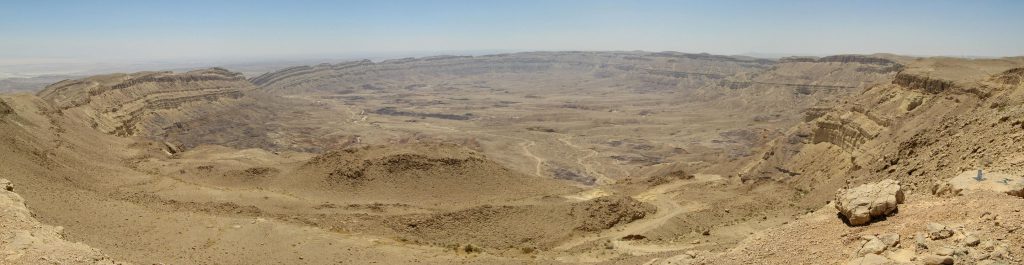
    Makhtesh Katan in the Negev – by Ester Inbar, available from http://commons.wikimedia.org/wiki/User:ST.

    For hikers familiar with American desert hiking, this isn’t significantly different. The logistics of water/supply caching can be a little easier than some desert hikes in the American Southwest.

    You’ll fall in love with the rust, purple, and ochre terrain, juxtaposed against the clear blue skis. Canyons and ridges, makhteshim (craters), acacia trees growing isolated by dry river beds…the land is ancient and spectacular.

    Make the Palmah Ascent, a route used by Jewish forces in the 1940s as they skirted British troops.

    Enjoy the renowned hospitality of the Bedouin while looking out for the Nubian Ibex, wolves, and the occasional camel.

    Jerusalem and Valley of Elah
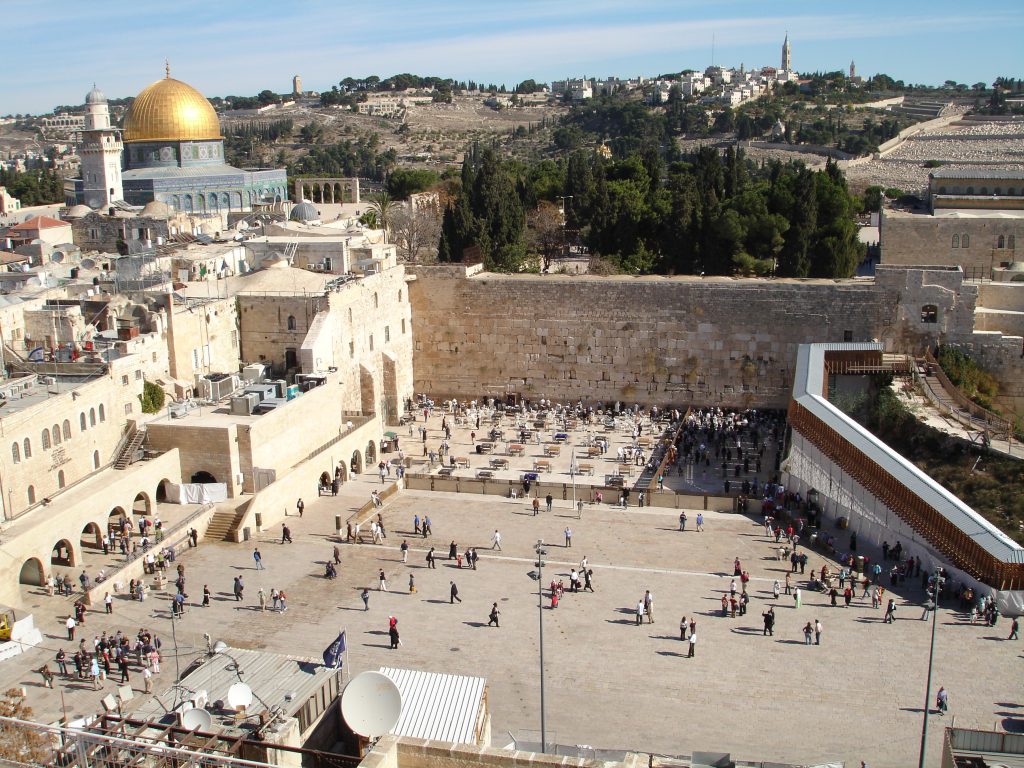
    We’ll do a separate post about it of these days, but with an additional 26 mile loop on the Jerusalem Trail, you can take in many of the amazing sights of Israel’s beloved capital.

    The North
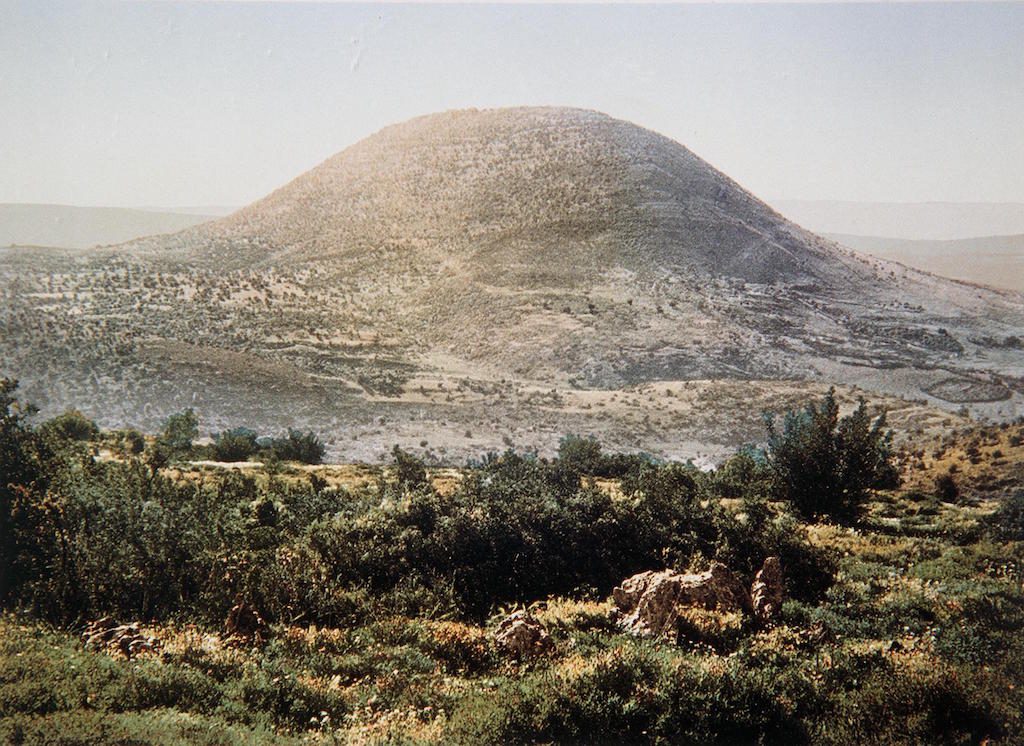
    COLOR PHOTO OF MOUNT TABOR TAKEN IN THE LATE 19TH CENTURY BY FRENCH PHOTOGRAPHER, BONFILS. צילום צבע מסוף המאה ה19 של הצלם הצרפתי בונפיס אשר תעד במצלמתו את נופי ארץ ישראל ותושביה. בצילום, הר התבור.

    Fertile farmlands, lush greenery that stands in contrast to the Negev, sites central to three of the Abrahamic faiths, Roman ruins, and so much more.

    So, you should know…

    Camping can be problematic. Sites are designated, litter is a problem, and Israelis are, well, interesting. They have a different regard for personal space and consideration of public conduct than people from the United States and Canada. If you can’t sleep through noise, many of the campsites on the INT will be a troublesome experience for you.

    Still, Israelis are well-known for their hospitality. If you don’t speak Hebrew, no worries, most signage is in English, and most folks you encounter will speak English, in many cases better than you do.

    Additional Resources

    Israel National Trail and Jerusalem Trail Guidebook

    https://www.israeltrail.net/

    http://theintexperience.com/ – Excellent online guide, broken down into sections

    https://israelhiking.osm.org.il/ – (Hebrew) online map, good chance to brush up on your language skills
  • Our Guide to a Wilderness Passover

    Our Guide to a Wilderness Passover

    We cover some of this in our book, The Kosher Backpacker, but as Pesach starts Friday night, there may be Jewish thru-hikers out there, or people availing themselves of spring break from school and chol chomoyed days of the holiday…so here’s a guide to a WILDERNESS PASSOVER.

    In a way, it’s kind of fitting. The Almighty lead our beleaguered people out of Egypt and into the wilderness for 40 years before letting us into the land. It’s a good time to commune with nature, and remember that if you have enough food for the 100 Mile Wilderness, dayenu.

    So we’ll go in order of events with the assumption that you may be traveling before and during Pesach…

    Selling Your Chametz

    Most of us coordinate the sale of chametz through our local rabbi, or via an online service, such as what is offered by Chabad.

    There’s an important fact – if your trip is taking you out of your usual time zone, it doesn’t matter where your chametz is, the sale is based off of where the owner of the chametz is! If you’re from the East Coast and are backpacking the Pacific Crest Trail, your local rabbi will buy it back too early. If you’re from the West Coast and are backpacking the Appalachian Trail, your local rabbi will sell it too late!

    If you know where you will be for the duration of the holiday, services offered by Chabad online will time it based off of where you are and a Chabad rabbi in the appropriate location will sell it for you. I suggest a donation if you use their service, of course.

    Searching for Chametz

    If you’ll be returning to your home from your trip during Pesach, then you should clean your house of chametz, and do bedikat chametz the night before you depart. If it’s outside the conventional search time, you omit the blessing.

    If you are staying at a backpacking hostel or hotel, you are required to do the search with the blessing in the room that you are leasing. If it’s an unpaid place, i.e. a trail shelter, you can still do the search, but consult with your rabbi for an absolute answer.

    It’s a good time to clean out your backpack and your tent, anyway. I haven’t been on many East Coast trails where rodents haven’t been relentless little buggers. Pesach can help keep them at bay, at least until they get their hands on some matzah crumbs.

    A Wilderness Seder

    I would hope most Jews traveling find a seder to attend, however, if you cannot, years of experience in the United States Army have taught me that we have seven total mitzvot that we can fulfill on our own.

    The mitzvot d’oraita of Pesach are:

    • Recounting Exodus
    • eating matzah

    The mitzvot d’rabbanan are:

    • Eating bitter herbs (maror)
    • eating the Afikomen
    • saying Hallel
    • four cups of wine
    • drinking that wine while reclining and starting the eating with a dip

    In our home, we use the ArtScroll Mesorah Series The Family Haggadah, but on the occasions that I’ve travelled or deployed, I have a laminated-yet-weathered Maxwell House Haggadah I use. I’ve found it’s an excellent opportunity to share our faith with non-Jewish friends.

    Kosher for Pesach Food

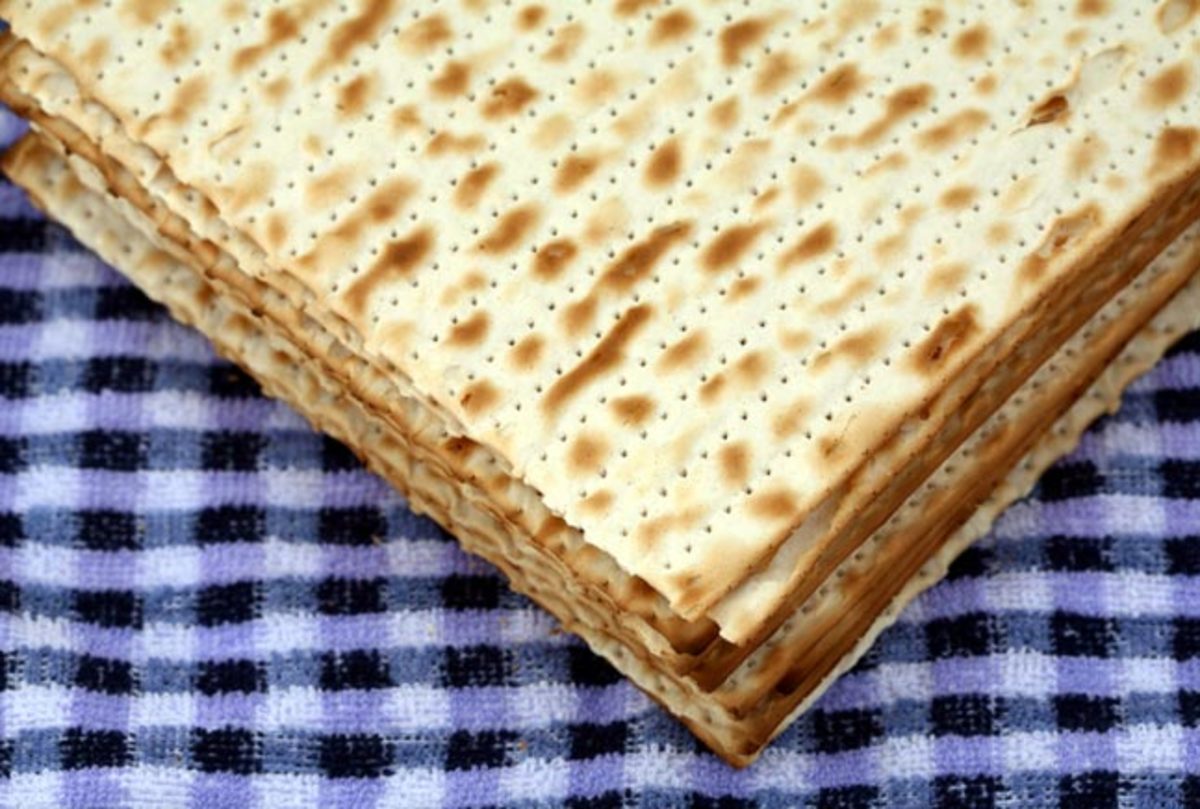
    This requires the most preparation. You would think that matzah would be a good trail food, but remarkably, it’s not all that wonderful. However, it packs better than most people would think, and you can add an element of awesomesauce to the holiday with store-bought or homemade chocolate-covered matzah.

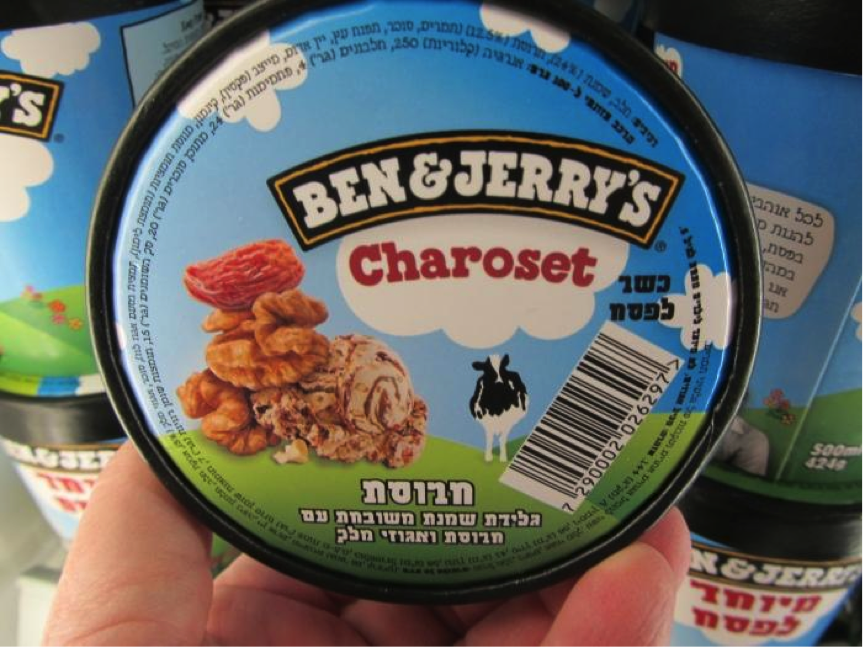
    One thing for Jews living outside of major Jewish communities – Pesach is the only time of year many of us can find kosher marshmallows. Leah and I stock up for this time of year in preparation not just for the 8 days of Passover, but for our Lag B’Omer bonfire.

    We have some recipe suggestions, including our Vegetarian Matzah Brei or our Salmon patties (ochlei kitniyot only). Matzah ball soup is surprisingly easy to make on a camp stove.

    If you are on a thru-hike, it is possible to place matzah and other OU-P or otherwise certified non-perishables in your “bounce box.”

    Final Recommendations

    I have an observant friend planning a trip to the Te Araoa Trail in New Zealand, but he is now postponing it because he would be leaving during the Omer, and crossing the International Date Line will hose his count. It’s an important consideration – Shavuos is determined by this count.

    If you would be obliged to say Yizkor for a departed loved one, make suitable arrangements to be in a synagogue on the last day of Pesach.

    Do you have any recommendations for Passover in the wilderness? Recipes? Tips? Stories? Share them in the comments below, or find us on Facebook.

  • Family Purity and the Outdoors

    Family Purity and the Outdoors

    This week’s parsha, Tazria (Leviticus 12:1–13:59) continues the exposition of our purity laws. In this portion, there’s purity after pregnancy, and tzaarat, which is often mistranslated as “leprosy,” handing during, and purity in the wake of.

    For many people, these aren’t exciting portions, and they may even be challenging to those who see these things as anachronistic. Many don’t like the stigma of uncleanliness associate with a new mother. Others may find sending someone with tzaarat outside of the city to be troubling.

    In The Kosher Backpacker, I reluctantly discuss purity laws, because for observant Jewish women, this can be one of the barriers for a deep and enriching outdoor experience. Why should a woman be denied the enjoyment of a multi-day paddling trip?

    As in many instances of Jewish life, mikveh immersion is one of those practices that has taken on a life of its own. We’re far from the Midrash annotating the component of Adam’s t’shuvah, by sitting in a river flowing from the Garden of Eden. At The Kosher Backpacker, we do encourage an entrepreneurial and informed DIY approach to wilderness Judaism, and we can put you in touch with a rabbi or yoetzet prior to your trip.

    On the East Coast, the ocean always can be a substitute for a mikveh, as can any river that doesn’t originate from rainwater. Most authorities agree that even if a river is swollen with rainwater, it still can be used as a mikveh, though we recommend finding a part of the water that is not moving.
    Here in Maine, leeches might be a dealbreaker.

    At a mikveh, you will have a shomeret or balanit, usually a woman who can help you. On a wilderness trip, you might not have a Jewish woman over the age of 12 to help you. In those cases, some authorities permit a husband to help you. The Shulchan Aruch (Yoreh Deah 198:40) says “…and if she has no one to watch her, or if it is night, she should tie her hair to her head with woolen threads or with the band that is on her head.” So while the halachah for most would be that a Jewish woman should observe immersion, there is an option for when there is no one available.

    In Israel, it is also now the law that women may be allowed to immerse alone upon request.

    We have more about this in the book, The Kosher Backpacker. We plan on producing helpful apps for the Apple Watch and for iPhone/Android phones that will help you remember your day counts for niddah.

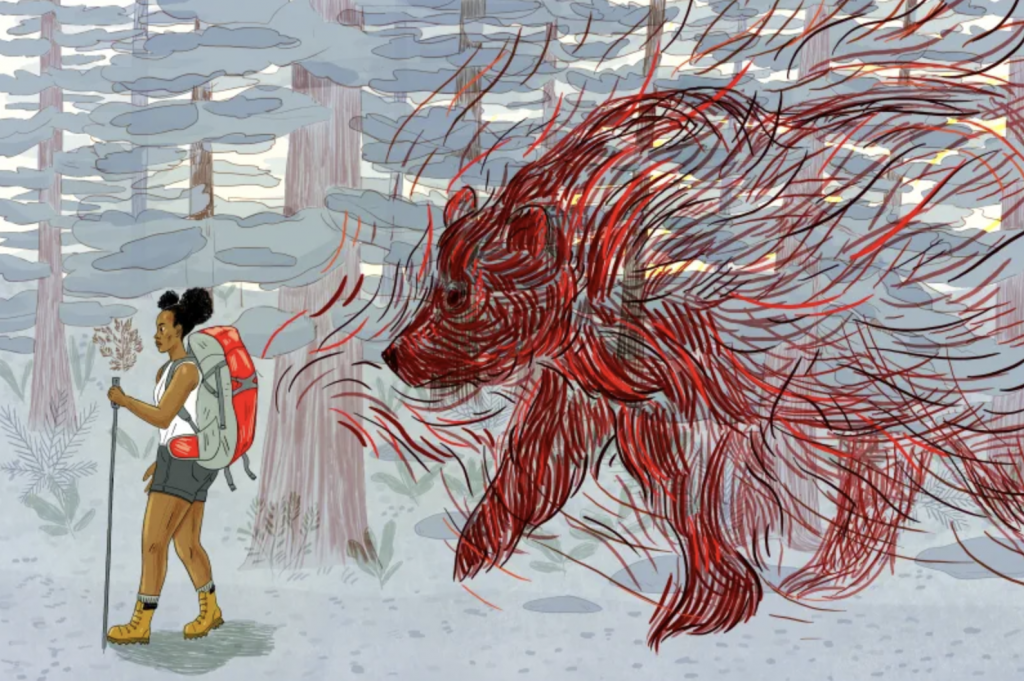
    On a less religious note, here’s some good news: bears in North America are not attracted to the smell of menstrual blood.

  • Our (Basic) Guide to Hammock Backpacking

    Our (Basic) Guide to Hammock Backpacking

    After my go-to camping mattress deflated on a cold, winter night in a shelter in the Adirondacks, I was ready for a change.

    It was a long circuit around and up the Seward Range. I prefer tents to shelters for a variety of reasons, not the least of which is to try and mitigate airflow around me when I sleep. I’m a warm sleeper to begin with, so I like to go lean as possible on my cold weather stuff for the sake of weight. It’s a delicate balance, and any disruption can lead to a night of shivering for me.

    I couldn’t find a flat spot, though, that wasn’t saturated in a cold, early spring rain, and into the shelter I went. A side sleeper generally, the mattress deflation made a bad situation worse.

    Later, I got a couple of deals on lightweight, nylon camping hammocks, and after setting one up in a copse of trees on our 12-acre property, I was hooked. Crawling into it on a Maine summer afternoon (outside of black fly season), I fell asleep as quickly as I seem to fall asleep in the living room after 8pm. And unlike with my usual tent and mattress combination, I woke up without my 40+ body swearing at me in Yiddish.

    We’re blessed on our property that I have a trail system and some great places to experiment overnight with new gear without catastrophic failure.

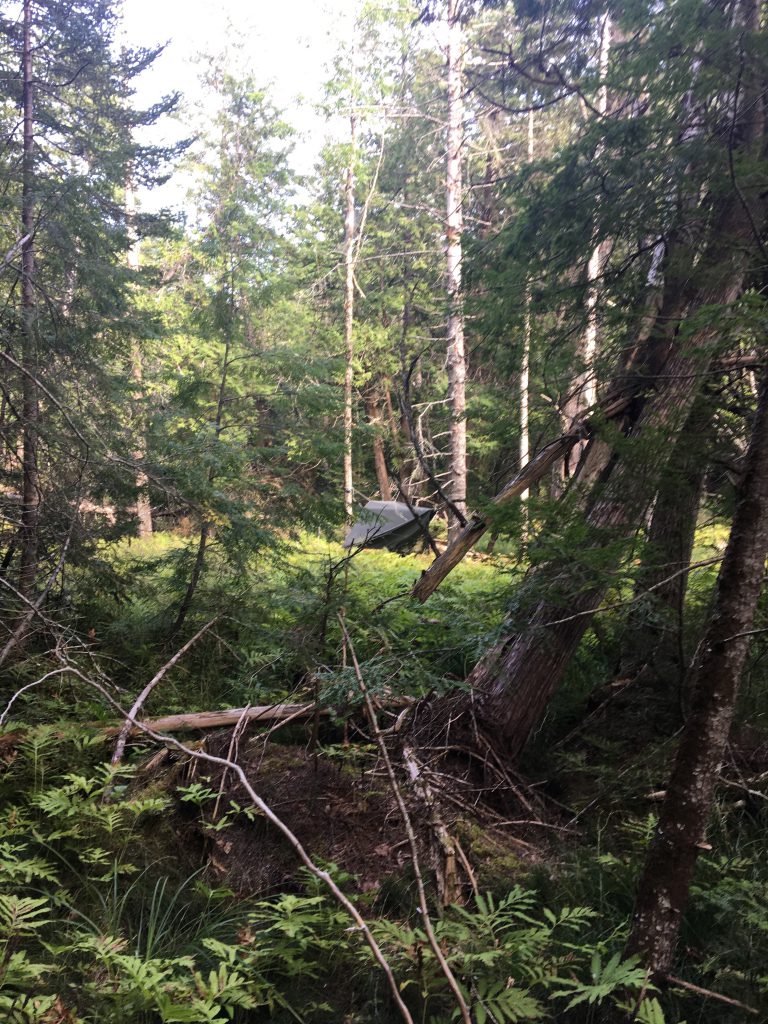
    Hanging around on the lower part of our acreage.

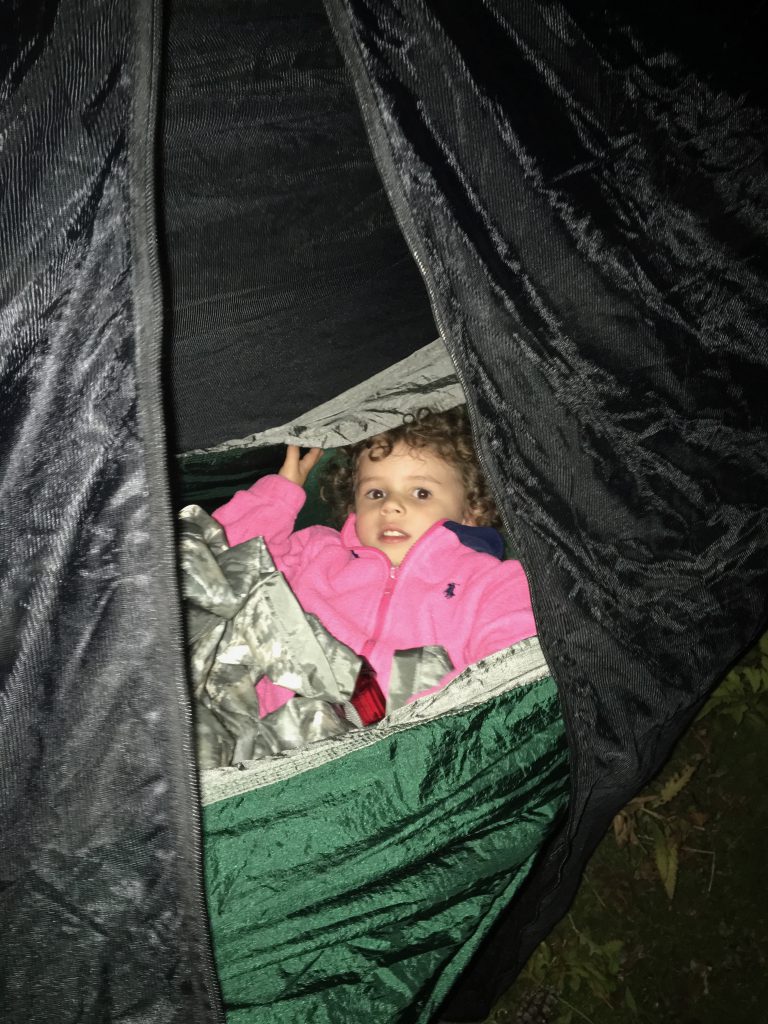
    I didn’t make a huge investment. I got a couple of deals on single and double hammocks, along with a lightweight bugnet, and I used the tarp from my National Guard issued gear. My toddler, Nezzie, crawled in me for the night. We were very comfortable, until the Maine chill set in.

    The author’s daughter, Nezzie, loved the double hammock

    I’ve long known about the need for an underquilt, so in the pinch, I used my military issue poncho liner, to great effect.

    And that was that, I’ve decided that for my future adventures, a hammock is the way to go. And it’s worked out since.

    Staying Warm: Pad or Quilt

    One of the biggest problems is that your points of contact with the hammock have naught but a thin layer of fabric between you and the outside world, and the outside world is here to freeze your parts.

    There are those that say you can get away with a pad, and this will work. For me, a simple foam pad with cuts taped along the side to wrap the width of the hammock helped. However, it limited me to sleeping parallel with the lines of the hammock, when diagonally might have helped my back a little more on a tough night.

    The better option seems to be a quilt. I’m not listing brands here today, but I can say, you can get lightweight options without spending a ton of money. Look for products with decent reviews on Amazon. People that tell you to spend a small fortune are often correct: you get what you pay for. Still, we have options with online shopping that we didn’t have in the past, and if you look for the right keywords in reviews, you won’t be disappointed, unless you’re a serious ounce counter.

    What I like about the quilt is that it fully stops the breeze and suffers me some more sleeping options. In the middling seasons, I can still get away with a lightweight fleece throw in addition to a 30 or 40 degree underquilt. Experiences will very. Best to experiment.

    Hanging: Whoopie Slings or Daisy Chains

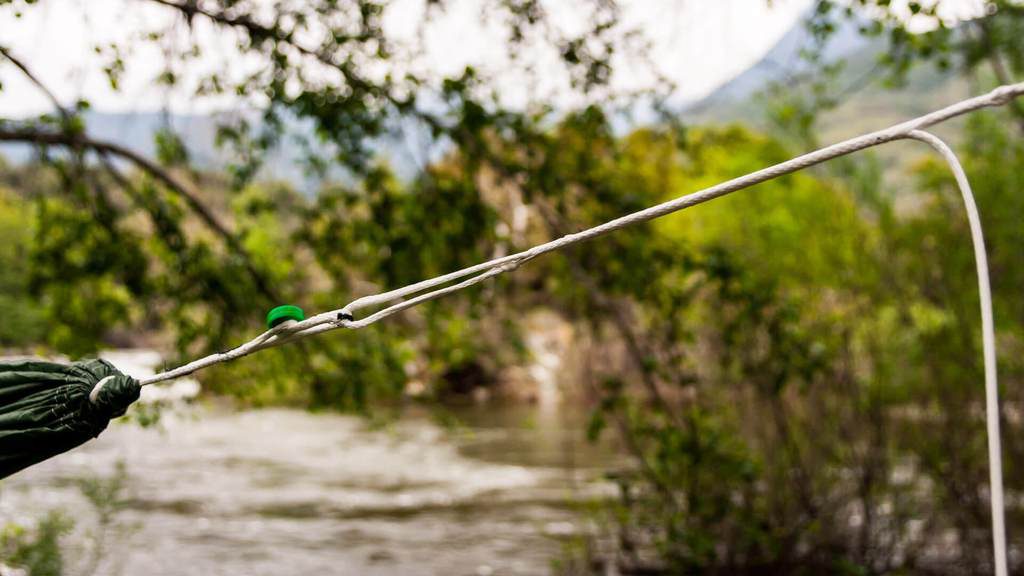
    from hummingbirdhammocks.com

    My hammocks have daisy chains, which have incremental places in either the webbing or the rope where I can place my carabiners in order to increase my hammock’s hanging tension.

    The whoopie sling is a lot more adjustable, and is sometimes lighter than the daisy chain option. The whoopie sling gives you an option for more refinement in your hang situation, and you need not break your bank buying them.

    The only thing I do discourage is using bark-damaging ropes for your hang. Do the right thing, buy or make straps that don’t eat into the trees you’re using.

    Bug Nets

    You could sleep with bug spray on you, or you can buy a bug net. Here in Maine, the black flies usually bite first and then think about the bug spray later, and even just the presence of a swarm is itself obnoxious.

    Again, you can find lightweight options without breaking the bank, or you can go all out with a combination hammock. I do like having mine non-integral to my hammock, because there are plenty of nights when I just haven’t needed it.

    Conclusion

    I like hammocks. The tarp/fly, bug net, underquilt, and straps will more than likely come in under the cost of tentage, if not in money, but also possibly in weight. And one thing I don’t struggle with on long thru-hikes is having a comfortable place to recline after a long day’s hike. It’s so eminently practical and comfortable.

    One thing that is difficult to overcome is the illusion of safety that comes with sleeping within the walls of a tent. These are fabric walls, people, not a structure fortified with sandbags. When I was stationed in Alaska, a wildlife photographer was pulled out of his tent and mauled/eaten to death. There is really not much of a security advantage in sleeping in a tent, on the ground.

    And if you’ve ever been woken up by a floating sensation, as I often have with tent camping, there’s a realization that there’s a dryness factor to hammock camping you may not have with a tent. And one thing I love a good deal is that if your fly is the last thing to come down in the morning when breaking camp, you can be reasonably sure that your gear can stay a smidge more dry than it would have otherwise.

  • On Tranquil Waters: Debsconeag Lakes

    On Tranquil Waters: Debsconeag Lakes

    After a test of my RAV4’s tires and suspension coming down a 4.5 mile stretch of rocks and pits, Amelia and I stood on the perhaps manufactured beach along the Debsconeag Deadwater at Omaha Beach.  We were swarmed immediately by Maine’s patent cocktail of black flies and mosquitoes, in spite of our best efforts with bug spray.  The nearby campground was filled with loud people.  I try not to be terrifically negative about “car campers,” as I’ve been one, but I find their presence in the wilderness intrusive, since they merely trade tent for house and drag along generators and radios.  Attempting to duplicate the comforts of home in a wilderness setting is, to me, ridiculous.  I’m not sure what bothered me more:  the insects or the blaring country music.  I could understand this at a trashy trailer lot “campground,” but given the inaccessibility of this serene locale off of the Golden Road, it was horribly out of place and diminished the character of the wilderness.

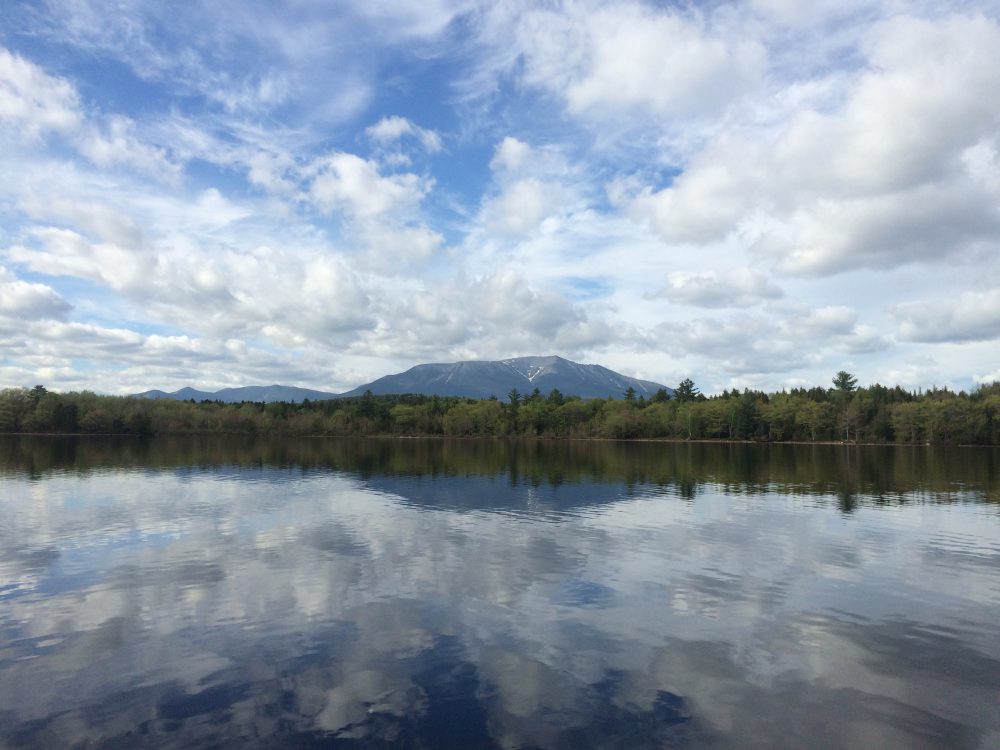
    Amelia enjoys some wading with Katahdin in background.

    Amelia enjoys some wading with Katahdin in background.

    This part of the West Branch of the Penobscot barely had a discernible current (hence “Deadwater?”).  As we put in and paddled away from shore, the bugs subsided. We headed west towards the inlet into First Debsconeag Lake, the alternating depths affording Amelia an opportunity for some wading.  The water was so still, and in the distance, the clouds cleared and we could see the lingering rivulets of ice in the spurs on Mt. Katahdin in the distance.  Once we got away from the din of the campground, the quiet was only broken by our conversation and our wooden paddles breaking the water.

    As we paddled towards the inlet from the Deadwater, on the left bank we saw some tell-tale sign of beavers.  Gnawed stumps, trees that were obviously “works in progress” by the prodigious rodents, and logs fallen into the water, but no sign of actual beavers.  As we rocked back and forth in the wake of a motor boat, we didn’t speculate long on the beavers’ invisibility.
    Our goal was to make it across the First Debsconeag Lake, take the portage to the Second, and find a wilderness campsite there.  The campsites along the First Debsconeag were generally occupied by waterborne variants on the class of campers at Omaha Beach.  They arrived with larger, motored watercraft, unloaded their “camp,” and polluted with noise ill-suited for the wilderness.  We knew taking the path to the Second Debsconeag Lake would take us away from this, as it was unattainable for people accustomed to easy travel.
    Unfortunately, the portage was unattainable for us, as well.  Amelia was determined to do it.  As I scouted ahead, she tested the scag-wheel built into the aft of our vessel by pulling it a good distance down the trail on her own.  Sadly, our canoe is 94 lbs with no yoke, our gear was slightly heavy, and it just wasn’t realistic, even for a quarter of a mile.  We ran the risk of scraping the bottom of the canoe absent a decent terrain-friendly cart.  Next time we’ll be better prepared.
    We acknowledged as we retreated back across the first lake that we would have to look for an empty spot alongside the offensive sprawl of the other campers.  We found one initially, only to have the helpful residents of one camp point us to a quieter, less obvious spot on the other side of their camp.  For all the fault I find with their form of camping, I’ve never encountered a group that are not marvelously friendly.  They even gave us some of their wood and lit a fire while we set up camp as twilight descended.
    We celebrated both Shabbos and Havdalah on our down day.  We ended Shabbos with Havdalah at our campfire, singing the Carlebach niggun for the introductory verse, and the Friedman tune for the blessings.
    After that, we roasted KforP marshmallows from our considerable stash Leah gathered from the Pesach clearance at Shaws or Hannaford.  Amelia relaxed in the hammock, until we went to bed.  In the morning, I woke up for my morning ablutions and laid tefillin under the cover of trees, after which I took in the morning light and looked without success for a moose or two.  When Amelia woke up, we had a breakfast of oatmeal and coffee singles, then put in, and returned home.
    This trip was why we moved to Maine.  Amelia and I have put our feet to most of the hikable east coast.  I’ve put my feet to most of the the continent, from Alaska to Florida, but there’s nothing quite like the tranquility of paddling in Maine.